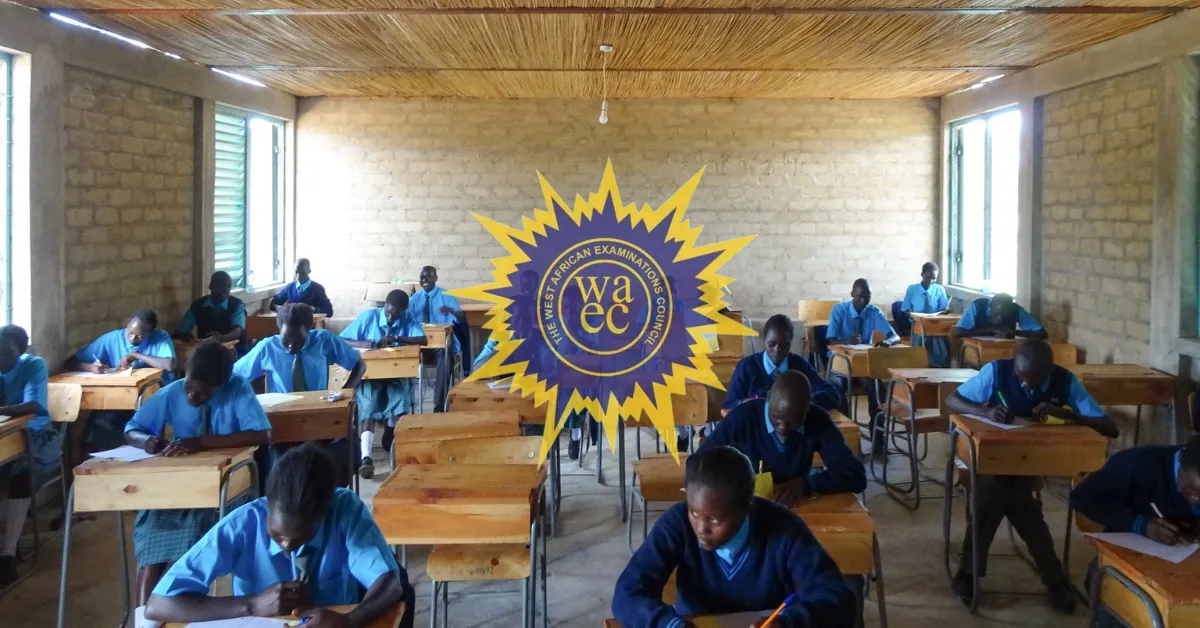
The WAEC Further Mathematics syllabus for 2026/2027 is a detailed guide for students who want to study advanced mathematics beyond the basic level. It helps teachers, students, and schools prepare for the West African Senior School Certificate Examination (WASSCE).
The syllabus covers three main areas: Pure Mathematics, Mechanics, and Statistics. It focuses on building critical thinking, problem solving skills, and the ability to apply math to real life situations.
It also prepares students for higher education in fields like engineering, science, technology, and economics. Candidates are expected to understand concepts clearly, think logically, and perform calculations accurately, thereby developing a strong appreciation for advanced mathematics.
Aims and Objectives
- Development of further conceptual and manipulative skills in Mathematics.
- Understanding of an intermediate course of study which bridges the gap between Elementary Mathematics and Higher Mathematics.
- Acquisition of aspects of Mathematics that can meet the needs of potential.
- Mathematicians, Engineers, Scientists and other professionals.
- Ability to analyse data and draw valid conclusions.
- Logical, abstract and precise reasoning skills.
Examination Scheme
There will be two papers, Papers 1 and 2, both of which must be taken.
PAPER 1:
This first paper will consist of forty multiple choice objective questions covering the entire syllabus. Candidates will be required to answer all questions in 1 hour for 40 marks. The questions will be drawn from the sections of the syllabus as follows:
- Pure Mathematics: 30 questions
- Statistics and probability: 4 questions
- Vectors and Mechanics: 6 questions
PAPER 2:
Paper 2 will consist of two sections, Sections A and B, to be answered in 2 hours for 100 marks.
Section A will consist of eight compulsory questions that are elementary in type for 48 marks. The questions shall be distributed as follows:
- Pure Mathematics: 4 questions.
- Statistics and Probability: 2 questions.
- Vectors and Mechanics: 2 questions.
Section B will consist of seven questions of greater length and difficulty put into three parts: parts I, II and III as follows:
Part I: Pure Mathematics: 3 questions.
Part II: Statistics and Probability: 2 questions.
Part III: Vectors and Mechanics: 2 questions.
RELATED ARTICLE:
WAEC Syllabus 2026/2027 for All Subjects: SSCE & GCE
WAEC Syllabus for Further Mathematics 2026/2027
| SECTION | TOPIC |
| Sets | Idea of a set defined by a property, Set notations and their meanings. Disjoint sets, Universal sets and complement of a set Venn diagrams, Use of sets And Venn diagrams to solve problems. Commutative and Associative laws, Distributive properties over union and intersection. |
| Surds | Surds of the form, a and a+b, where a is rational, b is a positive integer, and n is not a perfect square. |
| Binary Operations | Closure, Commutativity, Associativity and Distributivity, Identity elements and inverses. |
| Logical Reasoning | Rule of syntax: true or false statements, rule of logic applied to arguments, implications and deductions. The truth table |
| Functions | Domain and co domain of a function. One to one, onto, identity and constant mapping; Inverse of a function. Composite of functions. |
| Polynomial Functions | Linear Functions, Equations and Inequality Quadratic Functions, Equations and Inequalities Cubic Functions and Equations |
| Rational Functions | Rational functions of the form Q(x) = g(x) 0. where g(x) and f(x) are polynomials. e.g. f:x Resolution of rational functions into partial fractions. |
| Indices and Logarithmic Functions | Indices Logarithms |
| Permutation And Combinations | Simple cases of arrangements Simple cases of selection of objects. |
| Binomial Theorem | Expansion of (a + b)n. Use of (1+x)n ≈1+nx for any rational n, where x is sufficiently small. e.g (0.998)1/3 |
DOWNLOAD WAEC SYLLABUS FOR FURTHER MATHEMATICS 2026
Important Things to Note
1. Use of Mathematical and Statistical Tables
Mathematics and Statistical tables published or approved by WAEC may be used in the examination room. Where the degree of accuracy is not specified in a question, the degree of accuracy expected will be that obtainable from the mathematical tables.
2. Use of Calculators
The use of non programmable, silent and cordless calculators is allowed. The calculators must, however, not have a paper printout nor be capable of receiving/sending any information. Phones with or without calculators are not allowed.
3. Other Materials Required for the Examination
Candidates should bring rulers, pairs of compasses, protractors, set squares, etc., required for the subject papers.
They will not be allowed to borrow such instruments or any other material from other candidates in the examination hall. Graph paper ruled in 2mm squares will be provided for any paper that requires it.






No comments yet. Be the first to share your thoughts!