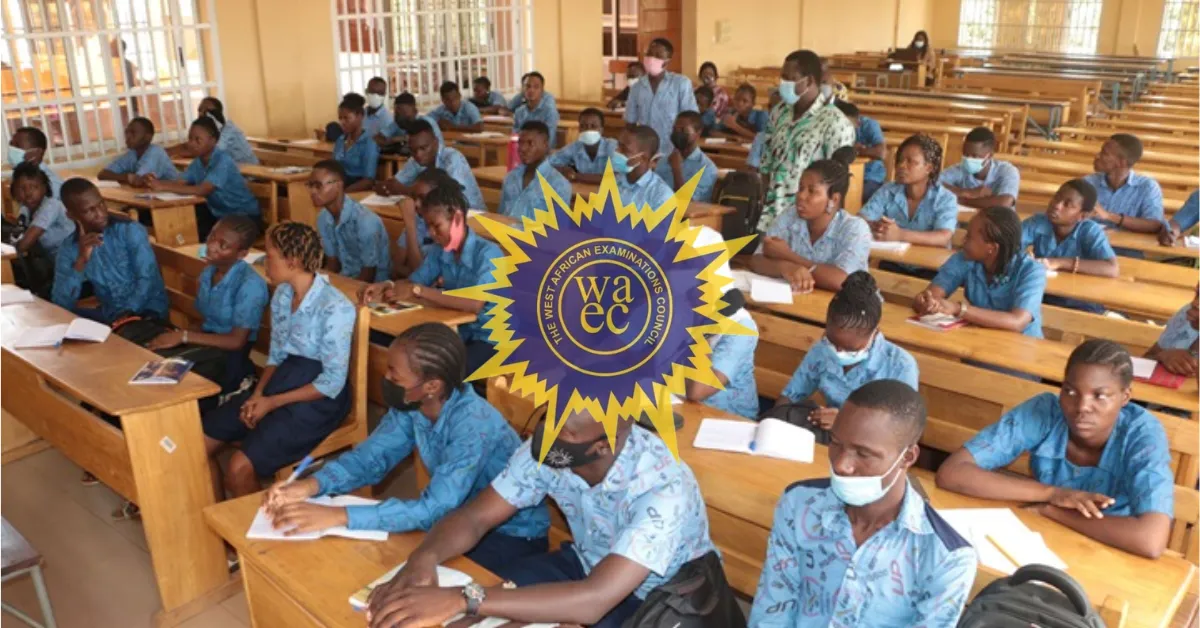
The West African Examinations Council (WAEC) French syllabus for 2026/2027 is the official guide for all candidates sitting the West African Senior School Certificate Examination (WASSCE) in French. It applies to both internal (school) candidates and external (GCE) candidates across all WAEC participating countries, including Nigeria, Ghana, Sierra Leone, The Gambia, and Liberia.
The French syllabus is drawn from the Senior High School curricula of member countries and seeks to impart to students with the requisite knowledge, skills, attitudes, and values to communicate effectively in French for personal development and understanding of, and participation in, the affairs of the sub region and the world at large.
WAEC French is particularly significant in West Africa, given that many neighbouring countries are Francophone. A strong pass in WAEC French opens doors to higher education, diplomacy, international trade, and careers across the French speaking world.
Aims and Objectives
This syllabus is intended to test the candidates’ ability to use the four language skills, namely, listening, speaking, reading and writing to promote communicative competence.
Examination Scheme
There will be three papers: Papers 1, 2, and 3, all of which should be taken. Papers 1 and 2 will be composite papers to be taken in one sitting.
PAPER 1:
Will consist of forty multiple choice questions to be answered within 1 hour for 40 marks.
PAPER 2:
Will consist of two sections with three essay questions each. Candidates will be required to answer two questions in all, one question from each section. Both questions will be answered within 1 hour and 15 minutes for 40 marks.
PAPER 3:
Will test candidates’ listening comprehension, reading, and conversation abilities. Each candidate will require 40 minutes for the test. The paper will carry 50 marks.
RELATED ARTICLE:
WAEC Syllabus 2026/2027 for All Subjects: SSCE & GCE
WAEC Syllabus for French 2026/2027
| PAPER | SECTION | DESCRIPTION |
| PAPER 1 | Section A: Comprehension | Tests candidates’ ability to read and understand French passages. Two 150 words passages with five multiple choice questions each. Candidates must answer all questions. |
| Section B: Structure | Tests candidates’ use of French words, expressions, and structural patterns in communication. 30 short questions to be answered. | |
| PAPER 2 | Section A: Essay | Tests candidates’ ability to write freely and correctly on general topics using appropriate grammar and style. There will be three questions ans candidates will answer one. Expected length: 100 words. |
| Section B: Letter Writing | Assesses candidates’ ability to write letters in correct French. There will be three questions and candidates will answer one. Expected length: 100 words. | |
| PAPER 3 | Listening Comprehension | A 200 words passage is to be read aloud by the examiner twice. Candidates study questions for 3 minutes before the second reading. 7 minutes to answer 10 questions, which may include multiple choice, open ended, transformation, and substitution. |
| Reading | Tests candidates’ ability to read aloud fluently with correct pronunciation. A 100 words passwill age will be provided. Candidates read once at a normal pace. | |
| Conversation | A 10 minutes test covering dialogue and exposition on general topics. Dialogue: Candidates answer at least 10 questions. Exposition: Candidates make at least 5 sentences on a given topic. |
DOWNLOAD WAEC SYLLABUS FOR FRENCH 2026
Recommended Texts for WAEC French 2026
Here are the texts recommended for revision and studies:
Course Books
- De Grandsaigne, J. (n.d.). France Afrique 4 (Lagos, Macmillan).
- Plaisant, C., et al. (n.d.). Trans Afrique 3 (Lagos, Macmillan).
- Ajiboye, T., et al. (n.d.). Nouvel Horizon 4 (Ibadan, Bounty Press Ltd.).
- Mazauric, C., et al. (n.d.). On y va 3 (Ibadan, Spectrum Books).
- Berard, E., et al. (n.d.). Tempo 1 & 2 (Didier, Hatier).
- Task Force (MEST). (n.d.). Et en français 1–3 (Freetown).
- Girardet, J., & Pécheir, J. (n.d.). Écho junior A2 méthode de français (Paris: CLÉ Internationale).
General Grammar Books
- Ajiboye, T. (n.d.). Companion to French Grammar (Ilorin, Info Links Publishers).
- Ferrar, H. A. (n.d.). French Reference Grammar (Oxford University Press).
- Dangnaud-Macé, P., & Sylès, G. (n.d.). Le Français sans faute (Paris, Hatier).
- Le Nouveau Bescherelle. (n.d.). La grammaire pour tous (Paris: Hatier).
- Soyoye, F. A. (n.d.). Manuel de conjugaison de verbes (Sophire Ed. Resources).
- Any other useful grammar books.
Oral Practice
- Ajiboye, T. (n.d.). An Introduction to Practice in Oral French (Revised edition, Ibadan, Bounty Press Ltd.).
- Grandsaigne, J. (n.d.). France Afrique 5 (Lagos, Macmillan).
- Adegbilero, L. M. (n.d.). Teaching Yourself French (with cassette/CD, Revised edition, Ibadan, Bounty Press Ltd.).
- Chamberlain, A., & Steele, R. (n.d.). Guide pratique de la communication (Paris, Didier).
- Any other useful document designed for Oral Practice.
Literature (Ghana Only)
- Dodoo, J. N. D. (n.d.). La Belle Fleure et d’autres Histoires (Accra).
- Ajiboye, T. (n.d.). Olurounbi ou Le Prix d’un Pari.
- Malot, H. (n.d.). Sans Famille (Paris).



No comments yet. Be the first to share your thoughts!