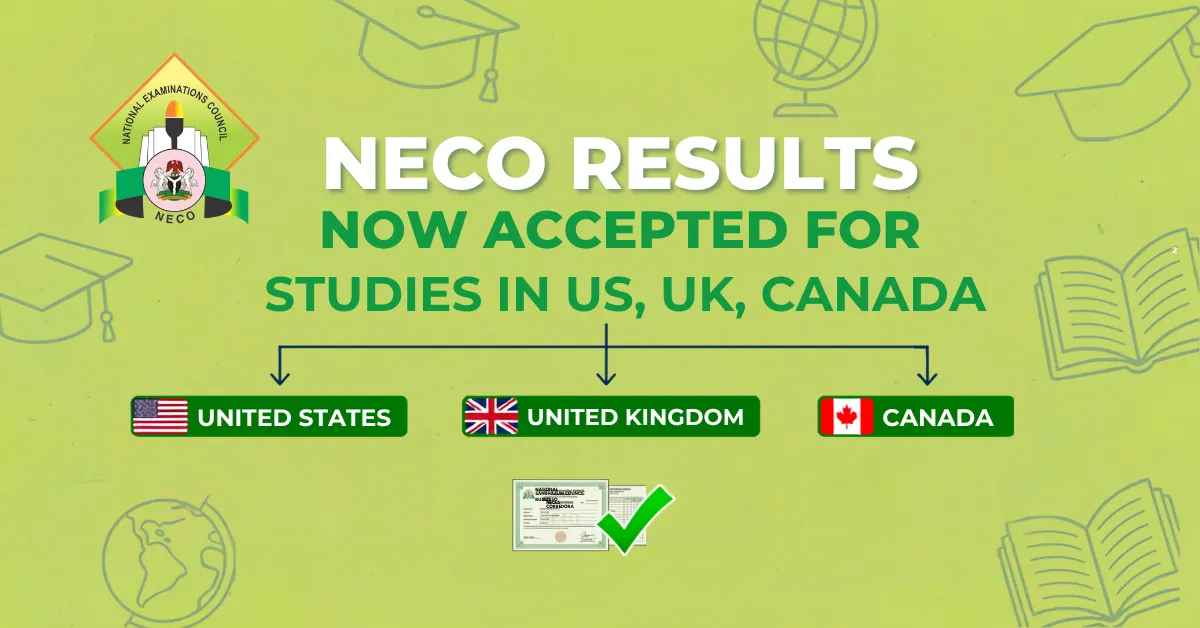
The National Examinations Council has revealed that foreign institutions in the United States, Canada, the United Kingdom and South Africa regularly submit requests to verify the academic results of Nigerian students seeking to continue their education abroad.
Prof. Dantani Wushishi, Registrar and Chief Executive of NECO, made this known in a brochure documenting the achievements of the examination body across its 25 years of existence. He noted that such verification requests are treated with urgency, as they reflect the growing acceptability of NECO results within the international education system.
Beyond its membership of the International Association for Educational Assessment, NECO maintained that its results are credible and meet global academic and professional standards. The council further disclosed that it has expanded its footprint into nine countries, including the Benin Republic, Niger Republic, Equatorial Guinea, Cote d'Ivoire, Gabon, Togo, Burkina Faso and the United Kingdom, positioning itself as a viable option for candidates across West Africa and beyond.
Since its inception in 2000, a total of 28,222,218 candidates have registered to sit for examinations conducted by the council, representing a 53.49% increase in enrolment.
Prof. Wushishi also drew attention to what he described as one of NECO's most consequential but underappreciated contributions to Nigerian education. According to him, the council effectively ended the dominance of a single regional body over post primary examinations in the country.
"Perhaps NECO's single most consequential achievement is one that is easy to overlook. It ended WAEC's monopoly over post primary examinations in Nigeria. Before 1999, WAEC administered senior secondary examinations for the entire country, a body headquartered outside Nigeria and designed to serve multiple Anglophone West African nations simultaneously. Critics had long argued that the arrangement compromised Nigeria's educational sovereignty and left the system ill suited to domestic curriculum priorities," he stated.
He added: "NECO changed this by conducting the Senior Secondary Certificate Examination for both internal and external candidates, alongside the Basic Education Certificate Examination and the National Common Entrance Examination, creating genuine competition in the assessment space. The data tells this story vividly: from its maiden examination in 2000, NECO grew its internal SSCE candidature from approximately 890,000 in 2000 to over 1.2 million by 2022, a cumulative total exceeding 24 million candidates across the period."
No comments yet. Be the first to share your thoughts!