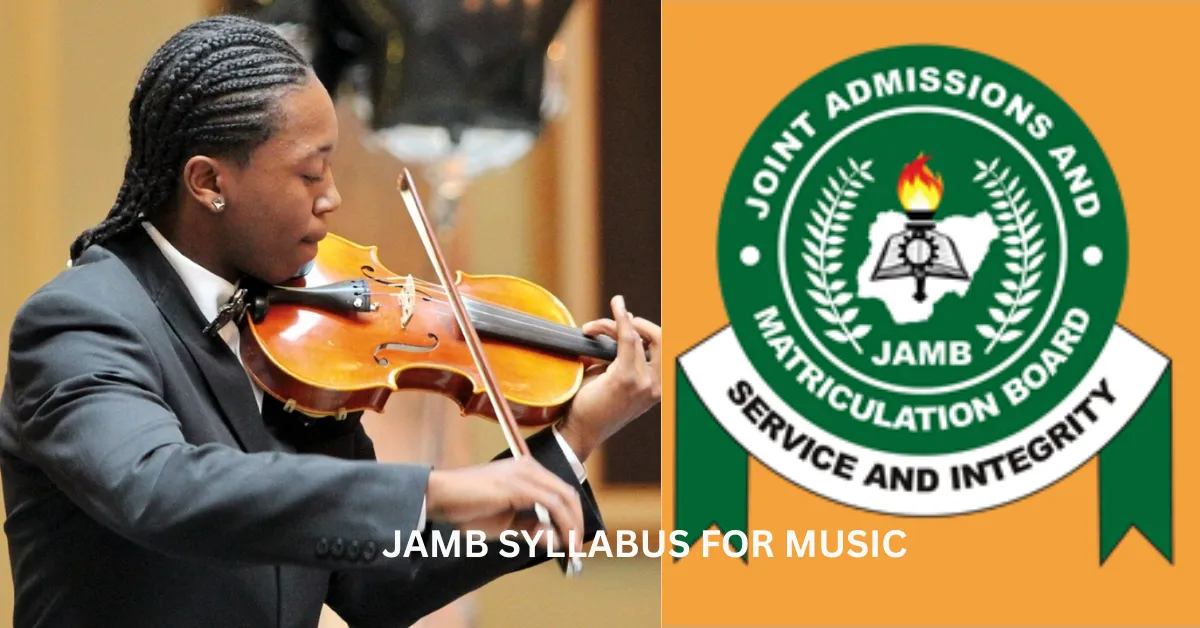
The JAMB Syllabus for Music introduces candidates to the vibrant world of sound, culture, and artistic expression. It covers a wide range of topics such as music theory, harmony and counterpoint, major historical periods and composers, folk traditions, and instrumental techniques.
This syllabus thoughtfully integrates African musical heritage with Western classical forms, helping students develop an appreciation for indigenous rhythms, traditional compositions, and performance methods.
Additionally, it assesses practical musicianship through score reading, notation, and instrument recognition. Working through this syllabus does more than prepare candidates for the UTME; it nurtures aesthetic sensitivity and cultural understanding, paving the way for future opportunities in performing arts, music teaching, and the entertainment industry.
General Objectives
The aim of the Unified Tertiary Matriculation Examination (UTME) syllabus in Music is to prepare the candidates for the Board’s examination. It is designed to test their achievement of the course objectives, which are to:
1. Appreciate and discuss the foundations of Music fairly and critically
2. Identify the features of the music of different periods through written/aural analysis;
3. Investigate the Western and African music theory, history, peoples, forms and medium of performance (including instrumentation);
4. Recognise the influence of socio cultural and technological factors (including computer software applications) on the lives and music of musicians;
5. Acquire a sound musical basis for further learning at the tertiary level.
RELATED ARTICLE:
JAMB Syllabus 2026 for UTME and Direct Entry Candidates
JAMB Syllabus for Music 2026
| TOPIC/CONTENTS | OBJECTIVES |
SECTION A: RUDIMENTS OF MUSIC (a) Great staff (b) Ledger lines and spaces (c) Open score (vocal score) and (d) G clef (Treble), C clef (Alto, Tenor, etc) F clef (Bass). | Candidates should be able to: i. identify all the components of the staff and |
| 2. Music Notes/Rests and their corresponding values. | Candidates should be able to: i. determine the relative duration of different notes and rests and their applications. |
| 3. Time signature (simple and compound time signatures), the correct grouping of notes and barring of unbarred passages. | Candidates should be able to: i. interpret varied rhythmic patterns; and ii. group and bar unbarred passage correctly. |
(i) Technical names of the various degrees of the scale (ii) Diatonic major/minor (natural, harmonic and melodic) (iii) Chromatic scales. B. Determination of the key of a piece of music with or without key signature NOT exceeding two sharps | Candidates should be able to: i. ascertain names of the various degrees of the diatonic scales and keys; ii. identify simple scale passages with or without key signature; and iii. differentiate between diatonic and chromatic scales |
5. (a) Keyboard setting and enharmonic equivalents (b) Accidentals | Candidates should be able to: i. identify the names of the white and black keys and their relationship, e.g. C sharp = = Bx; and ii. state function of the accidentals. |
6. Intervals 6a. Recognition of diatonic / chromatic intervals and their inversions (e.g. perfect unison, perfect 4th, perfect 5th, perfect 8ve), major/minor 2nd,3rd, 6th and 7th, diminished 5th and augmented 4th | Candidates should be able to determine different qualities of intervals (melodic and harmonic) and their inversion. |
| 7. Definition of simple musical terms, signs and abbreviations. | Candidates should be able to; i. interpret simple musical terms signs and |
8. (a) Transcription of music from staff into tonic solfa notation and vice versa. (b) Transposition using the treble (G) and bass (F) staves NOT exceeding two sharps and two flats. | Candidates should be able to: i. read music in any given notation both in staff and solfa notations; ii. rewrite a music passage on a given stave; and iii. transcribe from staff notation to solfa notation. |
DOWNLOAD JAMB SYLLABUS FOR MUSIC 2026
Recommended Texts
- Akpabot, S.E. (1986). Foundation of Traditional Music. Ibadan Spectrum Books, Nigeria.
- Agu, C.C. (1999). Forms and Analysis of African Music. Enugu: New Generation Books, Nigeria.
- Echezona, W. W. C. (1981). Nigerian Musical Instruments, Enugu: Apollo Publishing Ltd. Nigeria.
- Ekwueme, Lucy. U. (2007). Songs for Happy Little People, Lagos: West African Book Publisher Limited
- Hosier, (1961). Instruments of the Orchestra Oxford: Oxford University Press.
- Kamien Roger (2008). Music: An Appreciation. New York McGraw Hill Book Company.
- Kennedy, M. (1985). The Concise Oxford Dictionary of Music, (Third Edition), London: Oxford University Press.
- Kitson, C. H. (1978). Elementary Harmony Book 2, London: Oxford University Press.
- Kofoworola, Z. O., and Lateef, Y. (1987). Hausa Performing Arts and Music, Lagos: Nigeria Magazine.
- Mensah, A. A. (Undated) Folksongs for Schools, Accra.
- Mensah, I.T. (1990) Understanding Music. Books 1 to 3. Otuamic Publications.
- Nketia J. H. K. (1973). African Music in Ghana, Folksongs of Ghana. University Press, Accra, Ghana
- Osunniyi, J.A. (1994). An Easy Way to Learning, Lagos: Music. Jac Ola Printing Press, Nigeria.
- Robert Manford et al (1990). Music for Senior Secondary Schools. H. Gangaram Bombay
- Vidal, A.O. (2012). Selected Topics on Nigerian Music. Ile Ife: Imef African Music Publishers, Nigeria.







No comments yet. Be the first to share your thoughts!