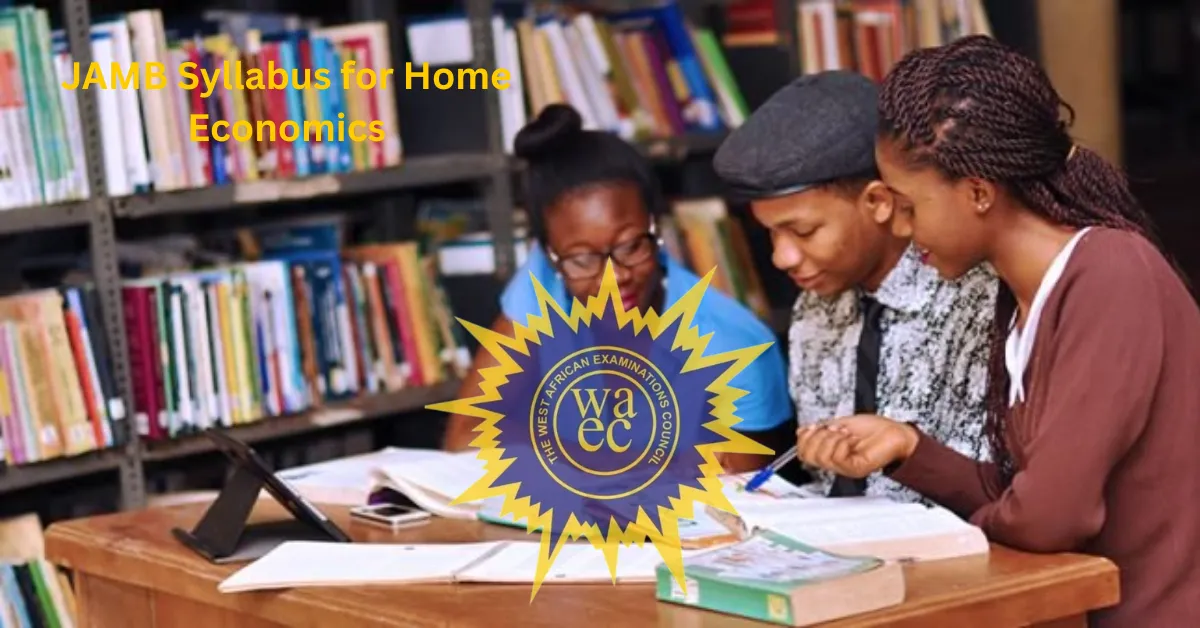
Home Economics is more than just a classroom subject; it's directly connected to how you live your everyday life. Think about the food you prepare, the clothes you choose, and how you arrange your personal space; that's all Home Economics. The JAMB syllabus is built around four key areas: foods and nutrition, clothing and textiles, home management, and family living.
You'll see topics like planning balanced meals, understanding how nutrients work in your body, choosing the right fabrics, making your home comfortable, caring for children, and knowing your rights as a consumer. These are skills that stick with you long after exams are over. We lay out every topic clearly so you know what to study and where to put your energy.
General Objectives
The aim of the Unified Tertiary Matriculation Examination (UTME) syllabus in Home Economics is to prepare the candidates for the Board’s examination. It is designed to test the candidate's achievement of the course objectives, which are to:
1. Acquire knowledge on the concepts and principles of Home Economics education;
2. Apply the principles of Foods and Nutrition to planning, selection and preparation of meals and the adoption of food hygiene and safety;
3. Equip students with knowledge and skills in Clothing and Textiles;
4. Apply the principles of Home Management in home and family living.
Related Article:
JAMB Syllabus 2026 for UTME and Direct Entry Candidates
JAMB Syllabus for Home Economics 2026
| TOPIC | OBJECTIVES |
1. Home Economics a. Meaning, scope, and importance of Home Economics. b. Objectives and ideals of Home Economics |
i. Examine the importance of Home Economics to the individual, family, and society. ii. Identify the objectives of Home Economics. iii. Determine the scope of Home Economics.
|
2. Areas/Careers in Home Economics a. Home Management: Interior decoration, Credit management, Florist. b. Foods and Nutrition: Catering, Dietetics, Nutritionist, Public Health Education. c. Clothing and Textile: Fashion Designing. d. Family and Child Development: Early and Childhood Education. e. Teaching f. Counseling g. Media h. Research | Candidates should be able to: i. Recommend possible vocations in the different areas of Home Economics. ii. Relate skills required to each vocation. iii. Assess the benefits of each vocation to the individual and society. iv. Identify current vocations in Home Economics. v. Identify sources of career information. |
3. Interrelationship of Home Economics with other subjects (Biology, Geography, Chemistry, Physics, Agricultural Science, Fine Arts, Economics, Mathematics, etc.) | Candidates should be able to: i. Compare the different areas of study from which Home Economics derives its knowledge. ii. Determine the contributions of these subjects to Home Economics. |
DOWNLOAD JAMB SYLLABUS FOR HOME ECONOMICS 2026
Recommended Texts
- Anyakoha, E.U. and Eluwa, M. (1990) Home Management for Schools and Colleges, Onitsha: Africana FIRST Publishers.
- Anyakoha, E.U (2006) Home Economics for Junior Secondary Schools, Books 1 to 3, Onitsha Africana FIRST Publishers.
- Haselgrove N. M. and Scallon K. A. (1981) The How and why Of Cookery. Granda Publishing Limited
- Neil, A and Hesmondhalgh, Z. (1985) A Complete Revision Course for O’Level and GCE, Revised Home Economics, Charles Co. Ltd.
- Ogunjide, L.O., Egbuchulam, B., Eyisi, O. Anfani Joe, M.E and Olusanya, J.O. (1993) Clothing and Textiles for Senior Secondary Schools 1 to 3, Ibadan: University Press Plc.
- Okeke S. U. N. (2009) Home Economics For Schools and College. Africana First Publishers.
- Olusanya, J.O., Eyis, O., Anfani Joe, M.E., Ogunjide, L.O. and Egbuchulam, B. (1990) Foods and Nutrition for Secondary Schools Books 1 to 3, Ibadan: University Press Plc.
- Olusanya, J. O., Olojala, S. O., Bala, F., and Eyisi, O. (2000) Exam Focus, Food and Nutrition for WASSCE and SSCE, Ibadan: University Press Plc.



No comments yet. Be the first to share your thoughts!