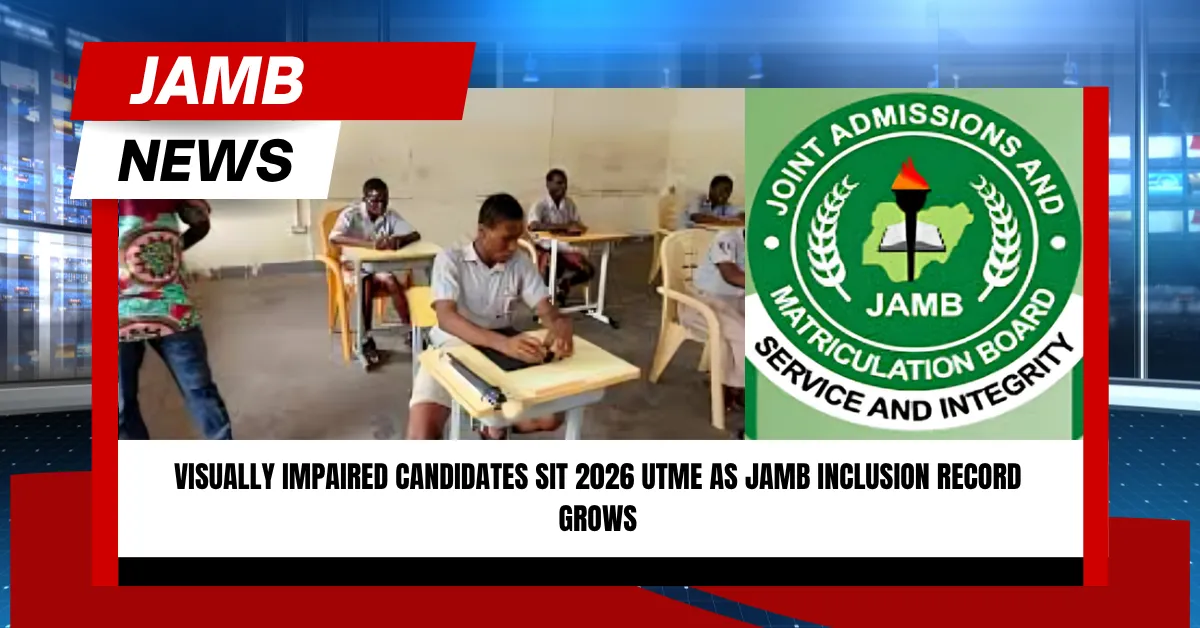
Special examination sessions for visually impaired candidates and others with disabilities commenced on Monday as part of the 2026 Unified Tertiary Matriculation Examination, with the Joint Admissions and Matriculation Board confirming that 536 candidates are being examined across 11 designated centres nationwide under arrangements tailored to their individual needs.
Emeritus Professor Peter Okebukola, Chairman of the JAMB Equal Opportunity Group and President of the Global University Network for Innovation (GUNi Africa), addressed journalists at the commencement of the sessions, commending JAMB Registrar Professor Ishaq Oloyede for sustaining an admissions framework that ensures no qualified Nigerian is excluded based on disability.
Okebukola disclosed that Kano recorded the highest concentration of candidates with 136, Lagos followed with 95, and Abuja hosted 46. The remaining candidates were distributed across Ado Ekiti, Bauchi, Benin City, Enugu, Kebbi, Oyo, Jos, and Yola, with each centre placed under the supervision of experienced academics, several of them former vice chancellors.
Candidates at the special centres have access to a bimodal examination system, allowing them to choose between a Fully Braille format and a Fully Read Aloud format. Okebukola noted that this system was being implemented for the third consecutive year.
"This approach, now implemented for the third consecutive year, has significantly improved accessibility and candidate experience," he stated.
Beyond the examination itself, JAMB has since 2017 provided candidates and their guides with free accommodation, feeding, transportation support, and customised examination materials through the Equal Opportunity Group.
Okebukola presented admission figures from the 2025 cycle showing measurable progress. Of 483 candidates with disabilities who applied for tertiary education, 252 gained admission, representing a 52.2 per cent success rate. Candidates with visual impairment accounted for 429 of the total applications, with more than half securing places. Candidates with Dyslexia recorded a 100 per cent admission success rate, while those with Down Syndrome, Autism Spectrum Disorder, and other conditions also posted notable outcomes.
He identified growing interest among candidates with disabilities in science, technology, engineering, and mathematics as an encouraging development, though he acknowledged that barriers remain for blind students in science related disciplines, with targeted efforts to resolve them ongoing since 2018.
Okebukola described the programme as a continental reference point, stating that the initiative had earned recognition across Africa as a model for inclusive tertiary education.


No comments yet. Be the first to share your thoughts!